When you’re buying a home, there are many things a traditional visual inspection can uncover—but some potential issues can be hidden behind walls, ceilings, floors, and other building materials.
That’s where thermal imaging can provide an additional layer of information.
Thermal imaging cameras allow a home inspector to see temperature differences across surfaces that may not be visible to the naked eye. During a home inspection, these differences can help an experienced inspector identify areas that may warrant additional investigation.
At Elevate Inspections, thermal imaging can be used as part of our inspection process to help provide buyers and homeowners with a more complete understanding of the property's condition.
What Is Thermal Imaging?
Thermal imaging, also called infrared thermography, uses a specialized camera to detect infrared energy and translate differences in surface temperature into a visual image called a thermogram.
Unlike a conventional camera, which captures visible light, a thermal camera detects heat signatures.
For example, two sections of a wall may look identical to the naked eye. A thermal camera, however, may reveal that one area is significantly warmer or cooler than the surrounding surface.
That temperature difference doesn't automatically mean something is wrong—but it can give an inspector a clue that deserves a closer look.
Think of It Like a Heat Map
A thermal camera essentially creates a map of temperature variations.
Depending on the camera and settings, warmer and cooler areas appear as different shades or colors. The inspector looks for unusual temperature patterns, rather than simply looking for a particular color.
This distinction is important because thermal imaging doesn't "see through" walls.
Instead, it detects the temperature of the surface of the wall, ceiling, floor, or other material being scanned.
What Is Thermal Imaging Used For in a Home Inspection?
Thermal imaging can be useful for investigating several areas of a home. Some of the most common applications include:
1. Identifying Potential Electrical Hot Spots
Electrical components can generate heat when operating. An unusual temperature pattern around an electrical panel, breaker, receptacle, switch, or other electrical component may indicate a condition that deserves further evaluation.
For example, a thermal camera may help identify an electrical connection that is significantly warmer than surrounding connections.
However, thermal imaging alone cannot determine the exact cause of an abnormal temperature. The inspector may recommend additional evaluation by a qualified electrician when appropriate.
2. Finding Potential Moisture Problems
One of the most useful applications of thermal imaging during a home inspection is helping identify areas that may be associated with moisture.
Water can change the thermal characteristics of building materials. Under the right environmental conditions, a thermal camera may reveal a temperature pattern that is inconsistent with surrounding areas.
This can potentially help an inspector identify areas for further investigation around:
Ceilings
Walls
Plumbing fixtures
Windows
Doors
Roof penetrations
Bathrooms
Kitchens
Laundry areas
Areas beneath plumbing lines
It's important to understand that thermal imaging does not directly detect water.
A thermal anomaly may be caused by moisture, but it can also have other explanations. An inspector may use a moisture meter, visual inspection, or other appropriate methods to investigate further.
3. Evaluating HVAC Performance
Thermal imaging can also be helpful when evaluating heating and cooling systems.
When an HVAC system is operating, thermal imaging may allow an inspector to observe temperature differences at:
Supply registers
Return registers
Ductwork
Air handlers
Accessible HVAC components
Areas around windows and exterior doors
For example, thermal imaging can help identify areas where conditioned air may not be distributing as expected.
It may also reveal unusual temperature patterns around ductwork or building surfaces that could warrant additional investigation.
4. Identifying Areas of Missing or Inconsistent Insulation
Insulation is normally hidden behind walls and ceilings, making it difficult to evaluate visually.
Thermal imaging can sometimes reveal temperature differences associated with inconsistent insulation.
A section of an exterior wall that appears significantly different from adjacent areas may indicate a potential insulation issue, thermal bridging, or another condition affecting heat transfer.
Again, the thermal image is a clue—not proof of a specific defect.
5. Detecting Potential Air Leakage
Thermal imaging can sometimes help identify areas where conditioned air may be escaping or where outside air may be entering the home.
Common areas of interest include:
Windows
Exterior doors
Baseboards
Attic access openings
Recessed lights
Plumbing penetrations
Electrical penetrations
Exterior wall transitions
Temperature differences can help an inspector identify areas that deserve closer examination.
6. Finding Unexpected Temperature Patterns
Sometimes thermal imaging is valuable simply because it can reveal something that wouldn't otherwise be obvious.
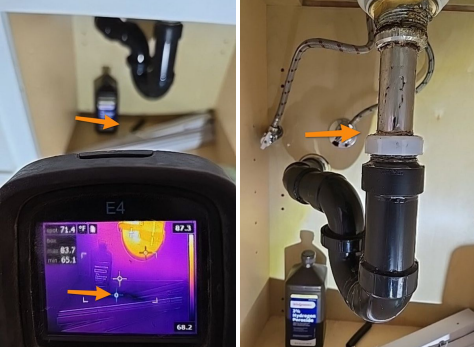
For example, an inspector may scan a wall and notice an unusual temperature pattern near a plumbing fixture.
That doesn't necessarily mean there is a defect. But it may prompt the inspector to investigate the area more closely using other inspection methods.
This is one of the biggest advantages of thermal imaging: it can provide another set of information for the inspector to consider.
What Thermal Imaging Cannot Do
Thermal imaging is a powerful inspection tool, but it isn't magic.
A thermal camera generally cannot:
See through walls
See inside plumbing pipes
Confirm that mold is present
Confirm that water is present
Identify every electrical problem
Determine the exact source of a temperature anomaly
Replace a visual inspection
Guarantee that a hidden defect will be found
Thermal images must be interpreted in context.
An experienced inspector considers the property's construction, weather conditions, HVAC operation, building materials, sunlight, moisture conditions, and other factors when interpreting thermal images.
Why Weather and Conditions Matter
Thermal imaging works best when there is a meaningful temperature difference between areas being evaluated.
For example, if you're inspecting a home on a hot Southern California afternoon, exterior surfaces exposed to direct sunlight can become significantly warmer than shaded areas.
That doesn't necessarily indicate a problem.
Similarly, HVAC systems need to be operating under appropriate conditions for certain thermal patterns to be meaningful.
This is why a thermal camera isn't simply pointed at a wall and used to diagnose whatever appears on the screen.
The inspector has to understand what they're looking at.
Thermal Imaging vs. a Moisture Meter
Thermal imaging and moisture meters can complement each other, but they do different things.
A thermal camera identifies temperature differences.
A moisture meter measures moisture-related conditions within the materials it is designed to test.
If a thermal camera reveals an unusual temperature pattern on a wall beneath a bathroom, for example, an inspector may use a moisture meter and visual inspection to determine whether there is evidence supporting a potential moisture concern.
Using multiple inspection methods can provide a much better understanding than relying on thermal imaging alone.
Is Thermal Imaging Worth It During a Home Inspection?
For buyers, thermal imaging can provide an additional level of information that isn't available through a traditional visual inspection alone.
It can be particularly useful when investigating areas involving:
Electrical • HVAC • Insulation • Air leakage • Potential moisture concerns • Temperature anomalies
But the biggest value isn't the camera itself.
It's the experience of the inspector interpreting what the camera shows.
A thermal camera can display an interesting image, but knowing whether that image represents a legitimate concern—or simply a normal temperature variation—is where professional judgment becomes important.
Thermal Imaging Is a Tool, Not a Diagnosis
One of the most important things to understand about thermal imaging is that it helps an inspector identify areas for further investigation.
A thermal anomaly does not automatically mean there is a defect.
Likewise, a normal-looking thermal image doesn't guarantee that a problem doesn't exist.
Thermal imaging works best when combined with a comprehensive visual inspection and, when appropriate, other inspection tools such as moisture meters and electrical testing equipment.
The Bottom Line
Buying a home is a major investment, and some potential problems aren't immediately visible.
Thermal imaging gives home inspectors another way to evaluate a property by identifying temperature differences that may otherwise go unnoticed.
When used properly, it can help inspectors investigate potential electrical issues, moisture-related concerns, HVAC performance, insulation inconsistencies, air leakage, and other unusual conditions.
At Elevate Inspections, our goal isn't simply to find things that look wrong. It's to help buyers understand the condition, function, and potential concerns of the property they're considering purchasing.
A thermal camera is one of the many tools an experienced inspector can use to help provide that additional perspective.
Thinking About Buying a Home?
A professional home inspection can help you better understand the condition of your investment before you make one of the biggest purchases of your life.
Elevate Inspections provides residential and commercial property inspections throughout Long Beach and the surrounding Southern California areas.
From the roof to the foundation—and everything in between—we help you understand what you're buying.